Twitter

BlogAds

Recent Comments

Label Cloud

Pay no attention to the people behind the curtain

Powered By Blogger
Showing posts with label Mark Green. Show all posts

Thursday, November 09, 2006

Two lessons for campaigns

One: The campaigns that won here in Wisconsin on Tuesday were the ones with the clear, unambiguous, crystalized messages--at least for the state-wide races. Consider:
  • The yes side of the amendment fight had a clear message the entire time--vote yes to "protect marriage." (I'm not saying I agree with it, I'm just using it as an example.) The no team, while they had just about the best GOTV efforts of anyone Tuesday, especially on the campuses, spent the last month of the campiagn muddying its message. The yes side stayed consistent, and no jumped from one message to another about the drawbacks of the second sentence, to keeping the status quo, to Tuesday's call about activist judges. The yes side's clearer message held out.

  • JB Van Hollen ran on a single clear message, too: He decided he was running for Batman. "I want to fight crime! I'll get the terrorists! I'll clear out the illegal immigrants! I want to date Commissioner Gordon's daughter!" I think it was a phony and misleading campaign (it took some kind of gall to suggest that a 14-year Assistant Attorney General didn't have the experience to be Attorney General). But Van Hollen stuck to it, unambiguously, and won even against a Democratic wave so large it knocked out Jack Voigt. On the plus side, Van Hollen will be so tired from fighting crime all night he won't do much damage during the daylight hours.

  • Mark Green's message through the whole campaign was an ill-defined "I'm not Jim Doyle" kind of thing. Green offered nothing beyond cookie-cutter Republican policies, borrowed or thieved from somewhere else. There was no bold, clear, unified message to truly distinguish himself from Doyle, or define himself without regard to Doyle. Even his attempts to ding Doyle for corruption failed, not least because he bore the stink of a corrupt Congress; throw in the fact that Tommy Thompson used to sell more state contracts by 9 AM than other governors do all day and, well, that didn't play with the voters. Doyle's initial message--Wisconsin is better off than it was four years ago--didn't seem to pay off, either. In fact, if you look at the polls leading up to election day, Doyle was having a hard time sealing the deal and couldn't get anything close to his actual vote total--until the last week. The last week, the issue became stem cells; the issue became Michael J. Fox. (I think the rape victim ad also helped crystalize it for Doyle's most key constituency, women.) Such clarity at the end attracted voters who, for 18 months of polling, weren't fully sold on Doyle.
So there it is: Find a clear and distinct theme, hammer it home, and don't muck it up.

Midday update: Seth makes this point much more eloquently today. By contrast, Jessica McBride, the professional pundit (!), sounds barely coherent trying to answer the question of why Green lost but Van Hollen won.

--

Two: There are, apparently, a lot of socially conservative Democrats in this state, Reagan Democrats, if you will. More than a quarter--getting near a third, maybe--of Doyle's vote total must have come from people who voted for the amendment. (A corollary: embryonic stem cell research doesn't seem to qualify as a social issue here.) I think that means a strong social agenda, including a repeal of our abortion ban in anticipation of a Roe challenge (as reader PK recommends in comments to this post), may not be the best way to start under new Dem managment in the legislature. Instead, I think the newly-empowered Wisconsin Dems need to look to economic issues--health care (which could have pro-woman positions, like eliminating the pharmacist "conscience" clause, for example), campaign finance reform, school funding reform, making UW more affordable again, and so on--as the way to begin the next legislature.

I'm sure that's not the end of what I think we should be taking away from this week. But it's what I've got for you this morning. The more I watch campaigns, and the people in them, the more I realize I should probably not tell people how to run their campaigns. Would the deicisions I would have made led to any different outcome? I don't know. But these two messages seem to stand out to me more than any others right now.

Wednesday, November 01, 2006

The English teacher reads his email

From an actual email inviting me to help out a candidate. It took me a while to figure out which one, so I made sure to highlight his name before posting this, so you wouldn't miss it. You may have to squint:


So you don't think I'm partisan (right now), I also got this invite from someone on my side:


My invited what?

Oh well. Back to work . . .

Monday, October 30, 2006

If the choice is so clear, don't muddy the water trying to explain it

In the first of a promised series on editorials about where the candidates for governor--Republican Mark Green and Democrat Jim Doyle--stand on "the issues," the Milwaukee Journal Sentinel today discusses the education platforms of each candidate. This issue happens to be one I know well, as a teacher and follower of education politics. And though I think they reach the right conclusion--Doyle is the better choice on education--getting there is a challenge.

In a sad effort to be fair to both candidates, the editorial board ends up offering their readers mush--it's about as shallow as your average Jessica McBride column. In an age when too many people feel there is no difference between candidates of either party, the editorial board does a disservice by blurring distinctions in a both-have-good-points haze.

It starts well enough, entitled "Education: It's about deeds," it gets underway reminding everyone that "when it came to putting money on the line for educational programs in Congress, Green has come up short--raising the fear he would repeat that pattern as governor." Indeed, on everything from fully funding No Child Left Behind to making student loans more affordable (as college gets less so), Green has failed to stand up for the side of education. And remember, this isn't just about putting money into the hands of those greedy teachers unions; no, this is about making sure families have access to opportunity and local schools don't have to make the difficult decision between testing and, say, art classes (ramifications ignored by the editorial).

But then the editorial dissolves into a puddle of he said-he saidishness and on-the-other-handisms. Take this line: "Clearly, school financing has to be overhauled. Both have said they would examine ways to do this." Horse hockey! Green has stammered out answers in response to pointed questions; Doyle actually convened a panel and put forward a proposal that died between his office and the legislature. (No, I didn't like the plan; but it's absolutely not a he "would examine ways" sort of thing.)

And the editorial again misses what I see as the two biggest red flags in Mark Green's education plan--the deceptively dangerous "70% solution" (dismissed with "it's unclear what it would take to reach Green's target") and the end of collective bargaining for teachers, which still has received no journalistic coverage anywhere that I've seen--not even from the teachers unions! (A fuller discussion of all of Green's plan is here.)

Though the editorial ends by noting that Doyle seems to be winning on education, at least, it does nothing to highlight what is indeed a stark contrast between where the two men stand on K-12 and higher education. The two paragraphs about the Milwaukee Parental Choice Program--the voucher program--are perhaps the perfect example:
Green's proposals on Milwaukee's voucher program are mixed. He readily supports the program--that's good. It has expanded educational opportunities for needy families. He wants to include private schools (not children) in the suburbs--not a bad idea. He also wants to lift the income cap--a worrisome step. The program must stay targeted at the needy who otherwise lack school options.

Doyle is no big fan of choice. But he was a key to expanding the program, giving it desperately needed breathing room. He deserves credit for this compromise, and, we'd note, his objections were aimed at getting more legislative support for smaller class sizes. A good thing, too.
Let me put that into English for you: Mark Green supports unfettered expansion of an unregulated and unproven system that puts taxpayer dollars into the hands of people who are not accountable to the taxpayers in any way--tax dollars that place an undue burden on the city of Milwaukee and are, in fact, partially responsible for the levy increase we learned about a couple weeks back. Governor Doyle supports working within the public schools to improve the education of all students, and (unmentioned by the editorial) bringing some measure of accountability to the private schools that take tax dollars. (His "compromise" was not strong enough on accountability--see, for example, here and here.)

That is a significant difference, and the paper plays it as "both have good points to make." No, they don't. Vouchers are, without question, the single biggest flashpoint issue in education in this state, and the two candidates will take radically different actions in office regarding the MPCP--not to mention their very different reactions, I suspect, when the incredibly pro-voucher legislature reconvenes. I recognize that the paper's editorial board and I disagree on the voucher question; but their downplaying here of the significant difference of opinion on the expansion of and need for accountability in the program does not, in fact, serve the voters' interests. Particularly when many of the voters they reach are directly impacted--through the tax implications, if nothing else--by the program.

I don't know what issue the editorial board will tackle tomorrow, but I hope that they do a better job of drawing the line between the two candidates--muddying the waters over what ought to be a clear choice helps no one make up their minds about this election.

Tuesday, October 17, 2006

The Truth Hurts

A couple of months ago, the Jim Doyle campaign started running an ad ("Stands," link opens in Flash video) claiming Mark Green votes with President Bush 92% of the time. Yesterday's paper ran a story saying that wasn't true; Green's average was closer to 90% and the study Doyle used was actually about how often Green voted with the majority of his Republican Party colleagues--a slightly different animal.

But the page-one headline, and accompanying story, was indeed about Green's support for Bush 90% of the time. In fact, the graphic that went with the story showed that Green was the most reliable Bush supporter from Wisconsin's delegation, voting with Bush more often than his peers four out of the last five years--and above the Republican average for those same four out of five years.

This seems to have touched a nerve, starting with someone whom I will not name on a blog I will not link to. He wrote,
Doyle is a lap dog to WEAC and the Indian Casinos, but the MJS cant find time to talk about that can they? Its times like these that remind me why the alternative media such as blogs sprung up in the first place.

So you people over at the Milwaukee Journal Sentinel when are we going to see the Headline

"Doyle votes with WEAC and the Indian Casinos 100% of the time"?
The kicker, of course, is that Doyle doesn't support the WEAC or casino line 100% of the time. As a WEAC member, I can think of a number of Doyle decisions that I personally and my union both disagreed with--notably his 2003-2005 budget and the "compromise" last spring on expanding the Milwaukee Parental Choice Program's vouchers. (Doyle, as I documented at the time, had been agitating for a similar compromise for some time.) Do I (and WEAC) still support Doyle? You bet, given what Mark Green has promised to do to public education in this state.

But it's odd how much the headline--"Green backs Bush on 90% of votes"--has raised the hackles. Why would Republicans be ashamed to have it known that Green supports Bush so much? Why is the response to a front-page headline that states a fact--one that, normally, a Republican Congressman might be proud of--so visceral and angry? (Fred calls the WEAC/ casino argument "brilliant," for example.)

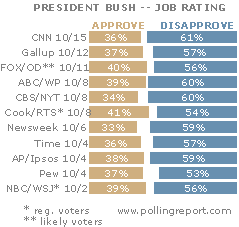
I think the problem is that the truth hurts. Given the fallout from the Mark Foley scandal, Bush may no longer be the least popular Republican in the country, but the chart on the right shows how decidedly unpopular he is. In Wisconsin, Bush had (last month) a 39% approval rating to a 59% disapproval rating. [UPDATE: The October numbers are just out, and they put Bush at 36-62!]

In the end, I'd welcome the kind of comparison Fred calls brilliant. If this election were held in a vacuum, and you asked voters to support either the man endorsed by Wisconsin's teachers or the man endorsed by President Bush, Doyle would win in a landslide. Wisconsin's teachers have a mind-blowing 77% approval rating.

So I say, bring it. Let's see that headline in the paper. Mark Green, make your commercials about how Doyle supports teachers and our public schools. Please.

Monday, October 16, 2006

[Blank] Jobs

You can fill in the blank.

A couple things struck me reading this morning's relatively in-depth article on the economic development platforms of Governor Jim Doyle and Mark Green. One, if Green is elected, he had better hope that Democrats take back the legislature, because his ideas won't get past those Republicans:
Green's goal would be to reduce the number of economic development programs to 10 or fewer. Doyle's most recent budget proposal, for 2005-'07, included a plan to restructure the Wisconsin Development Fund, which would have eliminated several inactive and outdated programs. The Legislature did not include that restructuring plan in the final budget bill. [. . .]

A current state tax credit for "angel investors," who provide funds for start-up companies, would be expanded from $6.5 million annually to $20 million, Green said. It was Doyle who started tax credits for angel investors as part of his "Grow Wisconsin" agenda. Doyle wanted to offer $10 million in credits annually. The Republican-controlled Legislature scaled it back to $6.5 million a year.

Also, Doyle's 2005-'07 budget expanded a program that provides tax credits to businesses expanding or locating in areas known as "enterprise development zones." The $243 million program was created in 1995, and $123 million in credits had been used by 2005. But the remaining $120 million in credits couldn't be used in recent years because of a limit on the number of development zones in Wisconsin. Doyle used his veto power to lift that cap. [. . .]

Green said states can pay too much to attract new jobs. But, he said, such incentives packages can be good investments based on the number of family-supporting jobs they help attract. [. . .] Doyle last year proposed $2.5 million in annual state grants for businesses moving to Wisconsin's border counties from other states. The Legislature did not approve that program.
Got it? Green wants to recycle a whole slew of Doyle's old ideas, ideas that in many cases were shot down by the very people now out campaigning for Green.

But what struck me even more in reading this is the extent to which the governor is expected to meddle in the process of development--an expectation that can only lead to a damned-if-you-do-damned-if-you-don't situation for anyone in that office. We already know, for example, that a tremendous double-standard exists for Gov. Doyle: If, for example, Doyle had leaned on the DNR about that whole Menard's flap, he would have been tagged as bending the rules for big campaign donors. Instead, he stayed out of it, Menard's built elsewhere (which probably had little to do with DNR anyway), and Doyle got tagged for not being aggressive enough in pursuing them.

Green, in this morning's article, trots out Honda. As we have discussed before, Honda was not coming to Wisconsin, no matter what we might have said or done. It wouldn't have made a lick of sense, and besides, the paper today tells us what it might have cost us:
For Honda, Indiana is providing $141.5 million in state and local incentives - or $70,750 for each job created. That amount includes money for future roads and other public improvements to accommodate additional commercial and residential growth tied to the Honda plant.
That's got to be more than the annual salary of those workers. Given how far away from scoring the plant Wisconsin actually was, can you imagine how much more it might have cost us? Is it, at those kind of numbers, worth it?

And here's the damned-either-way part: Had Doyle promised, say, $100,000 per worker in your tax money to subsidze the Honda plant, would he--could he--have gotten away with it? And what if there were campaign donations involved?

There are a whole lot of people who make good money complaining that neither political party is worth anything. Even the paper, in another of its annoying "kids, play nice" editorials, bemoans the lack of a focus on issues in this campaign. (They need a bit of a heal thyself moment.) But here we have a solid study on the issues, with seemingly no recognition that the whole concept--governors personally inserting themselves into the commerce of the state--invites at the very least the appearance of corruption, and at worst, a culture of actual corruption and putting business interests above those of the people, the environment, and the well being of the state.

And the irony is, that after all the negative press Mark Green has been able to stir up about Jim Doyle, Green's own plan--the part he hasn't stolen from Doyle--puts him even deeper into the mess:
Green would replace the Department of Commerce, the state's main agency overseeing economic development efforts, with a new public-private agency, called the Wisconsin Economic Development Corp. That agency would be led by a non-partisan board, chaired by Green, made up of industry, labor and University of Wisconsin System leaders.

The new agency would be more flexible than the Commerce Department and able to respond more quickly to changing business conditions, Green said. Having the governor lead the agency would create a more visible contact for businesses seeking economic development help, he said.
Not that I want Green to win, but if he does, I can't wait for the first time this new agency meets, Green firmly at the helm, and a business with $10k or $20k or $50k of donations to Green sitting across from him, asking for handouts. Middleman eliminated, Green would do a true job on the state of Wisconsin.

Tuesday, October 10, 2006

A Quiz: Mark Green and Copyright Law

I promised you a quiz yesterday, remember? But today's quiz is not, sadly, on yesterday's assigned readings. Instead, it comes to us by way of the improbably named Snooglepoop, which asks, "Mark Green, felon?"

Go read the case Snooglepoop makes, and then answer the question (Mark Green, felon?). This is an essay question, but not timed. You will be graded on originality and--sorry, Chris--grammar and punctuation. Submit your answers in the comments below. And no cheating!

(Fred, you will lose points for talking photoshop.)

Friday, October 06, 2006

McIlheran Watch: Lies and the Lying Liars Edition

Patrick McIlheran, my true "MSM" nemesis, has picked up Jessica McBride's recent assertion that I control the media spin on the story or whatever. He blogged yesterday:
Spivak and Bice wondered the other day how long until the Democrats start demanding Mark Green return any money they got passed along by disgraced and resigned Rep. Mark Foley’s campaign.

Doubtless, the only bottleneck is studio time to make the ad. Compunctions clearly form no bar to the Doyle campaign, which still shows no shame over usurping the state Elections Board.

And, as Jessica McBride points out, the Dems’ peanut gallery is already singing along, with one Milwaukee blogger already making the absurd contention that John Gard, not yet in Congress, is somehow part of a coverup.
Let's start with some absudities here: By the time (6:00 pm Tuesday) the Spice Boys "wondered" about when Dems would demand the return of the Foley money, Green had already announced (Monday evening) that he would donate the $1000 from Foley's PAC in 1998 to charity, and, as that AP story notes, the state Democratic party had already called on Green to return it. The Spice boys seem a little slow on the uptake, there. There's just no excuse for McIlheran, writing two days after the Spice Boys, for not knowing that Green figured the cash was still toxic eight years later and gave it up. (Yesterday, but after McIlheran's post, Paul Ryan, the only other Wisconsin Republican who got Foley money, gave his away, too, though I don't know that anyone actually called for it.)

Then there's the part of McIlheran's post that's about me--the "one Milwaukee blogger" contending that Gard "is somehow part of a cover-up." That's not what I said; that's not even what McBride said I said. She wrote,
What was Gard's "offense?" He took money from Republicans being accused of "protecting" Mark Foley. Gard's not even in Congress yet! In other words, it's all below the belt.
She thinks I wasn't being fair when I said "Gard needs to explain how and why he thinks it's a good idea to keep $27,000 in PAC money from men who knowingly participated in the cover-up of crimes and inappropriate behavior." I can see her point, but as I wrote yesterday, that's a legitimate question to ask.

To be fair, what McBride links to is not actually the post here on my blog, but the re-posting of it I did at the World's Biggest Blog, Daily Kos, which you can read here. But I wrote the exact same sentence about Gard there.

So in three paragraphs, McIlheran blows it several ways, without even touching the unfounded spin about Doyle's "usurping" the SEB. P-Mac tries a dig at Dems for probably wanting to demand that Green give back money Green had already unloaded; he misrepresents what Jessica McBride wrote about me; and, in the process, misrepresents what I actually said.

But that was not, in my eyes, McIlheran's biggest sin in that post of his. No, that came at the end, when he wrote,
As Dean Barnett points out, this is oddly like the Wellstone funeral affair: Democrats letting their emotions carry them too far.
I've gotten riled up about this before, in part because I really, really liked Paul Wellstone, and in part because the conservative lies and myths about the Wellstone memorial service are among the basest and most disturbingly false accusations that they peddle--and they are also pervasive. But they are lies, and the Barnett piece McIlheran links to repeats them all:
Democratic partisans opted to use his metaphorical coffin as a campaign prop while trying to rally the faithful. [. . .] But what made the Wellstone Memorial noteworthy was its raw ugliness. Republican dignitaries who attended the event to show their respect for Wellstone were booed when their images were shown on the Jumbotron. Many fevered-swamp type Democrats saw nothing wrong with this. The country recoiled from the spectacle, utterly repulsed and shocked.
I wrote about these lies two summers ago after the death of Ronald Reagan, anticipating, correctly, that Republicans would compare and contrast the Reagan memorial service with their imagined scenes of partisan rallying at the Wellstone memorial. As I wrote then,
There were eight speakers in all, besides George Latimer, the former mayor of St. Paul who acted as MC. Iowa's Tom Harkin was the only elected official to speak; the rest were friends and family of the victims. One of them, whom Wellstone described as "there is no one person outside of my family that I admire and love so much" Rick Kahn, ended his eulogy with an impassioned plea to carry on the legacy of Paul Wellstone, and to "win the election for Paul." That was the only political moment. A couple of minutes, tops, out of four hours of remembrance, where things got a little partisan.

But that didn't stop those with an agenda from lying. Immediately after the memorail, Coleman's campaign manager Vin Weber was in front of cameras to denounce the whole thing as "a political event [. . .] a complete, total, absolute sham." And of course Limbaugh was on the air the next day blubbering about it. And the TV pundits, too. Everyone seemed to take that one small slice at the end of Kahn's speech and extrapolate to believe that moment was representative of the whole event. And boy were they indignant.

Their claims ranged from Trent Lott getting booed by the whole audience (there was a smattering of boos, but he smiled and waved) to the whole event's being scripted, including telling the audience when to applaud and jeer (evidenced by the words on the Jumbotron--you know, the closed captioning that was there for the deaf). They claimed Republicans who wanted to speak were shouted down by the partisan crowd--but the only people on the schedule were the ones delivering the eulogies; there was no open mic. And more.
Al Franken, a partisan, yes, but also a friend of Wellstone and someone who was at the memorial, has since written an account of that service for the Huffington Post, which is worth a read.

McIlheran's sin of lying about the Wellstone memorial is complicated by the fact that he doesn't seem to care that some of us have genuine emotions about the Foley scandal not prompted by partisan glee. As I said earlier this week, I teach high school students, boys and girls of the same age as the pages Foley was emailing and IMing. It is revolting to me, literally nauseating, to believe that anyone could have looked at even the "overly friendly" emails that surfaced first last week and decide that there was nothing wrong or creepy or worth investigating about them. For me, this isn't (just) about getting the Republicans; this is about the instinct I have cultivated my entire professional career to protect these children.

Patrick McIlheran is a parent. If he cannot find the same sense of moral outrage within himself . . . Well, I don't want to even think about it.

Sunday, October 01, 2006

Republicans' Live Boy; or, It's Not the Crime, It's the Cover-Up

By now, you've almost certainly heard that Floridan Republican Congressman Mark Foley was forced to resign after news broke of, apparently, years of his inappropriate (and possibly illegal) on-line activities with underage House Pages. There are some awkward emails from the past year or so, as well as some pretty bad IMs from a couple of years back, that paint a disturbing picture of Foley.

Now, there's no question that Foley's regination was the right thing, as is the universal condemnation of what he did. The problem is that the Republican leadership both knew about Foley's Page problem for almost a year now and they did nothing but try to cover it up. Everyone from Majority Leader John Boehner to Speaker Dennis Hastert knew about the issue, and, rather than force Foley out a long time ago--or offer a full-blown investigation--they chose to sweep the mess under the rug.

Among the more incredible details is that the House Page Board not only did nothing to stop Foley, but they purposely left the Board's sole Democrat out of the process, thereby keeping the whole thing soley under Republican control. They have no one but themselves to blame for the unravelling of this cover-up.

As much as the Right Cheddarsphere loves to blame the words and actions of even the most fringe Democrats on the leadership of the party (even going so far as to say, for example, that the Democratic National Committee calls Bush a murderer, though only those farthest-out and least connected to the leadership ever get close), I would have expected to see more criticism directed at the Republican leadership. But after a tour of the usual suspects, I found that only Owen condemns the corruption at the top of that ladder.

And there is an incredibly sad irony to all of this: Foley was Co-Chair of the Missing and Exploited Children Caucus in the House, and remained so right up until his resignation Friday. Foley was apparently instrumental in getting the "Adam Walsh Child Protection Act of 2006" passed--a law that, as Glenn Greenwald points out, Foley was violating. Josh Marshall has been following this story closely (see this post for a taste of that sad irony, just as an example).

There are also some Wisconsin connections. No Wisconsin Republicans are in the House leadership, of course. However, our very own F. Jim Sensenbrenner, as Chair of the House Judiciary Committee, helped shepherd the Adam Walsh Act through Congress, and, in fact, stood near Foley as Bush signed the bill. (Foley's House website has been scrubbed, and apparently they're working fast to get his name off of everything. The Google search that led me to that link named Foley in the caption to the picture, but the caption now does not name him! This is a screenshot of another photo that's been scrubbed, but the caption still indicates that Foley and Sensenbrenner were there together.) An email to Sensenbrenner's campaign asking about that day--and about whether Sensenbrenner's made a statement on the matter, since I couldn't find one--has not yet been returned.

And Mark Green, now running for governor, also has Foley connections. He's not released a statement (nothing here, here, or here) that I can see. But Green should be at least a little concerned, since a $1000 contribution from Foley's PAC helped Mark Green first win his seat in 1998. Again, an email to Green's campaign about this has gone unreturned.

I've said it before and I'll say it again: Mark Green (and F. Jim) are members of the most corrupt Republican Congress--the most corrupt Congress, period--in memory. That the leadership would willing protect an internet predator is just a drop in the bucket here, yet typical of what you might expect of a Republican Caucus that would change its rules to protect indicted leaders.

It is a shame that it's taken the proverbial "live boy" to make that clear to so much of the public.

Thursday, September 28, 2006

Dirty Money

Let me start by offering a partial apology to John McAdams related to my post Tuesday. In that post, I noted several times how McAdams returned to the theme of laundering "dirty money" while he was on Wisconsin Public Radio, and I said that no one was making that charge. I had not seen that charge made in a TV commercial (one benefit of TiVo), but I suppose I probably had seen it come up in one or more press releases against Mark Green's transfer of funds from his federal account to his state account. My larger point, the one I was trying to be clear about and probably wasn't, is that while he was on the air, no one made that charge. He kept coming back to it--and arguing against it--as a way, I believe, of avoiding talking about some of the issues callers like me actually raised. And the case against that argument that no one made on the air is, indeed persuasive, so I can understand why he kept using it.

But more to the point of this post: I think any strategy on this issue--Mark Green's having broken the law by transferring this money--that tries to make the implication that this is "dirty money" misses the mark, for several reasons.

First of all, I firmly believe that most voters already believe that a significant portion of the money in politics now already is "dirty money," even if that money is perfectly legal (as those PAC and individual contributions to Green's congressional campaign indeed were at the time). I think this is compounded by the fact that in Wisconsin, the individual contribution limit for the governor's race is ten thousand dollars. Consider how much different the Adelman Travel accusations would have sounded if we learned that the company's executives had only given, say, $500 a piece to Doyle's campaign. Just the mere mention of a ten thousand dollar contribution has the smell of corruption on it, even though legal, even though no one but anti-Doyle bloggers has connected Doyle to the violations of law in that case.

In short, saying that Green's PAC money is "dirty money" isn't going to move voters away from where they are.

Second, I think focusing on the PAC money or the PACs themselves distracts from the real story here. Face it; Mark Green thought what he was doing was legal when he did it--a whole lot of us did. That, in fact, is the persuasive part of the noise McAdams was making on the air: We all know that Green carefully sought advice about the transfer and did it in good faith. Sadly, the people whose advice he got, including the State Elections Board's counsel, were not the ones who ultimately ruled on the matter, not the ones whose opinions counted. So the real story--and the part of the story that really, really makes Mark Green look bad--is that, once told he'd broken the law, he said, "Forget you. I'm doing it anyway."

The story should be not that Green or his money is "dirty," but rather that he's a scofflaw.

For example, my friend Tim Schilke--whom I love dearly and who has the unenviable position of being the only liberal columnist in Waukesha County--writes this week about the story and gets it wrong. Here's how he closes:
So what’s the big deal anyway? Why not allow Mark Green to use any money he can gather in his campaign for governor?

One only has to look at Schedule 1B from Green’s fund conversion to answer that question. Do you really want to see JP Morgan PAC from New York ($2,500 converted), Pfizer PAC from New York ($6,000 converted), Glaxo Smith Kline PAC from Durham, N.C., ($5,500 converted), and Bank One PAC from Chicago ($10,000 converted) exerting undue influence over the governor’s office in Madison?
Well, no, of course not, is that answer to the question. But that question gets a no answer regardless of whose PAC contributions we're talking about--Green's or Doyle's. Saying that PACs are bad is axiomatic, even if some of us give to PACs and even if some of the nation's leading campaign finance reformers have PACs of their own. Continuing to harp on the notion that the money itself is tainted isn't going to move the voters away from where they are.

Third, I think Green's initial refusal to follow the SEB's order is the biggest mistake he's made in this campaign. Admittedly, on his part, he took a gamble, figuring that trying to rally support around what he perceived, perhaps rightly given the SEB's actions in 2001, as unfair treatment would be a winner for him. But he also took the chance of being painted as a scofflaw--an opportunity that I do not believe Doyle, the Democrats generally, and the issue groups on Doyle's side have fully taken advantage of.

Green's situation is compounded now that the case has gotten a wider examination in the light of not just SEB precedent--which is neither binding nor, apparently, trustworthy--but of state and federal law. The more we learn about the statutes govenrning campaign finance in this state and nationally, the more it looks like (and, sure, I'm biased here) Green broke both state and federal laws. Check my archives from the last week or so for a fuller explanation of why I believe that to be the case.

And, as a result of that deeper examination of Green's transfer and the laws governing it, the non-partisan Wisconsin Democracy Campaign, which brough the initial complaint to the SEB against Green, is now filing a complaint with the Federal Elections Commission. An FEC ruling against Green, though not likely to come before the election, means not just the return of up to $1.2 million of the transferred funds, but fines, fines, fines.

Had Green just said, last month when the SEB made its order against him, that he'd follow that order and let it go, the story would be dead now. As it is, the opportunity is still there to make the case: Green is a scofflaw. He seems to have broken state and federal law, we say, whether he meant to or not; and now, instead of following that law, he's trying to get away with it.

That's the story that might move voters--Green knows he broke the law and he's trying to get away with it--not any tale of "dirty money."

--

Another rich line of attack to exploit might be that Green is now lying in his campaign ads. From this morning's paper:
[Green's new] ad says the Journal Sentinel reports that Gov. Jim Doyle "secretly rigged a state Elections Board vote to try and steal the election."

Don't be fooled. The newspaper didn't write that. News stories reported on calls from a Doyle campaign attorney to Democratic members of the Elections Board before a key vote that was to determine if Green should return nearly $468,000 that went from his congressional campaign fund to his governor campaign. Another news report cited a call from the state Republican Party head to a board member on the same matter.

A Sept. 22 editorial mostly bemoaned the blatant partisanship of the Elections Board in that vote and urged reform that would remove partisanship from such decisions. Specifically, it urged passage of legislation that would have removed the partisanship.

But the editorial also agreed with board counsel that there was likely nothing illegal about those calls, though it welcomed an investigation into whether open meeting laws were broken. So, "rigged?" "Steal?"
A few weeks back, Doyle came under pressure for using unedited footage from Madison TV news reports about the SEB's order against Green. There was no accusation that he was taking things out of context or misstating the stations' reporting. Here, it's clear that Green, perhaps reading between the same lines as the rest of us, is misrepresenting what was actually reported. If Doyle should have stopped his ads--and many on the right made it clear that's how they felt--Green certainly should. (Besides the contact's having been legal, there is also no evidence--and, indeed, evidence to the contrary--that either the Doyle lawyer's emails or the GOP executive director's phone calls actually changed anyone's mind.)

So this is what we've got: Green is told he broke the law, thumbs his nose at it, and then lies about how the story's been reported.

That's a compelling narrative on its own. You don't need to start throwing around charges of "dirty money" to make that story work.

Tuesday, September 26, 2006

The rest of my conversation with Professor McAdams

Driving home yesterday, I found Marquette Professor John McAdams (known in the Cheddarsphere as the Marquette Warrior) on my radio. He was on Ben Merens's WPR program (you can listen to the archived hour here), talking about the only news story of the day yesterday--a judge's ruling in Mark Green's attempt to get an injuction against giving up nearly a half-million in PAC funds transferred in from his federal committee last year. In case you missed it, the judge said no go (read the full decision here (.pdf)).

McAdams, no surprise, was defensive of Green, and continued to rail against a charge that I didn't hear anyone making--that this was "dirty money"--and that Green is somehow slimy for having it. I'm not calling Green slimy, certainly, and no one else did either. Not even the Wisconsin Democracy Campaign, which brought the complaint originally, called it "dirty money"; they just merely said that the PAC transfers were in violation of state law. In addition, we have since learned that, among other things, individual contributions in that federal transfer were made by people who have also maxed out their donations to Green's state campaign, putting a number of individuals over their statutory contribution limits. Again, this money is not "dirty," and no one is accusing Green of "laundering" money--but McAdams apparently likes his straw men and kept that up for much of the hour, including in response to my question.

I called in (I was, I think, the second caller after the 4:30 news break) because I wanted to bring up a key element in the judge's decision, which was that Green's transfer of funds actually seems a violation of federal law--something neither McAdams nor the other callers had mentioned. Even the on-air producer seemed incredulous when I told him that's what I wanted to talk about, because he'd apparentlty not heard of it either. I made another point first, though, because I heard McAdams say that Green's campaign had treated the transfer of funds as a "lump sum," rather than as individual contributions, and that that was what made the transfer okay.

For some 30 years, I said, the Elections Board has required all of these transfers to be itemized; in other words, Green could not have assumed this could be treated as a lump sum rather than itemized contributions. Then I made my point about BCRA (McCain-Feingold): Under the law at the time Green made the transfer, he would have had to comply with state law, which made at least some of that transfer illegal. In fact, under McAdams's assertion that the transfer was a lump sum, then that actually would have made almost all of that transfer illegal. From the Wisconsin Dept. of Justice brief (.pdf) in the case:
In late 2004 [. . .] Congress amended BCRA by [. . .] allow[ing] federal campaign committees to move funds to state campaign committees, but only in the form of "donations," and such donations were required to be made in conformance with state law. The impact of this change in BCRA for Wisconsin was that a federal campaign could now make a donation to a state or local campaign committee in Wisconsin, subject to the applicable laws regarding such donations. In Wisconsin, a committee is limited by statute to only contributing certain amounts to campaigns. For Governor, for example, a committee may contribute no more than $43,128. Therefore, following the 2004 amendments to BCRA, a federal campaign committee was limited to contributing no more than $43,128 to any candidate for Governor in Wisconsin during an election cycle. [. . .]

At the time the federal funds were converted for Green, the law governing the use of federal funds in a state campaign was codified in [federal and state law]. Nowhere in either statute was the wholesale conversion of federal campaign funds to a state campaign allowed. Indeed, quite the opposite was true.

If the federal campaign committee funds are "converted" (as Green maintains) to a state campaign committee as separate, segregated contributions, then the contribution limits would apply. Alternatively, if the converted federal campaign committee is but another committee and is converted as a single, unitary lump sum, that amount becomes a lump sum that is subject to the limits of a committee [i.e., $43,128]. To suggest, as Green does, that it can avoid compliance with [Wisconsin law's pre-January 25, 2005] limits simply by calling these funds a "conversion" rather than a contribution (when the term "conversion" does not even exist in the state statutes) would allow coy semantics to undermine the clear mandate and purpose of [Wisconsin law]. A duck does not become a goose simply because one calls it a goose.
Or, for my Minnesota readers, a gray duck.

So McAdams wanted it both ways--as, apparently, Mark Green does. The transferred funds came in a lump sum, so that they're not subject to limits on PACs and individuals. But at the same time, they were funds from PACs and individuals, so they're not subject to the $43,128 limit on "donations" as provided by the federal law (incorporating Wisconsin statues) that was in effect at the time.

Now, unfortunately, I was in my car, and I didn't have all of that in front of me. If I did--and if a low cell battery and time constraints would have allowed me a follow-up--I would have challenged McAdams's curt dismissal of my question, since he still seemed stuck on the "the day after" line about the State Elections Board's Emergency Rule.

Now, it is true that the SEB met the day after Green transferred his money (it was nice of the SEB to give notice when that meeting would be, so Green could have a deadline). But that meeting, on January 26, 2005, was, as the DOJ notes, "for the purpose, among others, of reviewing potential rule revisions to harmonize the Board's rules with the changes in federal law" that took effect December 8, 2004. Regardless of when the rule changed, I wanted to tell McAdams, the law prohibited the transfer as it happened at the time it happened. Period.

I'm guessing that McAdams had not read the DOJ's brief, since he seemed oblivious to all of that. I'm also guessing he hadn't read the judge's decision, since he also seemed oblivious to the ruling itself. And that ruling, as a part of making the case that Green would not get the injuction, made it clear that the logic McAdams was using was both faulty and contrary to the plain language of all the governing statutes--federal and state--on the day that Green made his transfer. From the decision:
In short, a "donation" under [BCRA] is a "contribution" subject to the limitations and other regulations contained in Chapter 11 of the Wisconsin statutes governing the use of money in Wisconsin political campaigns. Thus, even if the court were to adopt Green's argument that the Elections Board should be enjoined from enforcing its Emergency Rule and Order because they are illegal for any number of reasons--arguments which raise some serious and legitimate questions--Green still cannot succeed in the ultimate merits of this case because the Court cannot grant the requested declaratory judgment finding "that funds a state campaign committee has on hand when it converts from a federal registration are not counted against Wisconsin's contribution limits." Controlling federal law, through its incorporation of Wisconsin's campaign finance law, in fact compels the opposite finding.

For the same reasons that Green cannot demonstrate that he will likely succeed on the merits of the case, he falls short of showing irreparable harm if the temporary injunction is not granted. That is to say, whether the Elections Board is enjoined from enforcing the Emergency Rule and Order or not, Green's duties under the law remain the same. Under [BCRA] and Chapter 11 of the Wisconsin statutes which it incorporates, Green must subject the donation from the federal campaign to the provisions of Wisconsin law governing "contributions" to political campaigns. Thus, at least at this very preliminary stage of the lawsuit where pleadings are not even complete, it is simply unnecessary for this Court to enter the thorny procedural and constitutional thicket created by the Election Board's actions in promulgating the Emergency Rule and issuing its Order, let alone allow it to sidetrack the Court's decision on Green's Motion for Temporary Injunction. The bottom line is that the Elections Board reached the correct result, regardless of the infirmities, if any, in its process.
McAdams's response to me completely avoided the implications of the judge's ruling; instead he railed against people claiming Green was "laundering dirty money"--a claim I didn't make at all. McAdams also tried the Tom Barrett precedent, ignoring the fact that the law has changed since 2001. ("Green seeks to exploit this same [Barrett] loophole," the DOJ notes, "even though the board's decision in Barrett was not only wrong as a matter of law, it has long been rendered moot by intervening changes in the law on both the federal and state level.")

So here are my further questions to McAdams: How can you be so completely dismissive of the law? Do you really mean to say that you believe that Green's transfer should not have been limited by what Wisconsin law allowed on the day he made the transfer? Why do you insist on trying to have it both ways--that these were individual and PAC monies but not subject to the limits on those? How is it that you can spend a significant portion of your hour on the radio battling straw men, instead of addressing the issues of substance raised by callers, the DOJ, and the judge's ruling?

I realize, of course, that the radio conversation is over. But, Professor, you're welcome to use the comments below to answer.

--

On a related note, and a propos to my post of last Friday, Seth Zlotocha made a prediction yesterday that turned out to be right. Sigh.

Friday, September 22, 2006

Anti-Doyle MJS Editors Driving Campaign Narrative

A couple of years back, during the 2004 election season, I got an email from a reporter at the Milwaukee Journal Sentinel who could not believe, as he called it, the "hard right in its political coverage this fall. [. . .] Every day gets sadder. The only way its going to stop is if someone calls the editors on it, and that's not something that's going to happen from inside the paper."

Well, I'm calling the editors on it now: There is indeed a very clear pattern of the Journal Sentinel's news editors driving the narrative around the campaign for governor over the summer and now into the fall.

The latest round is but a symptom: In yesterday's paper, they give lengthy, front-page-above-the-fold treatment to legal (though monumentally stupid and ethically iffy) behavior on the part of the Doyle campaign--and, as Gretchen Schuldt notes, bury as an afterthought on page seven the story of Mark Green's dodging campaign contribution limits, an activity that is, indeed, illegal.

Bill Christofferson (I think) noted a while back--though I can't find the link now--that the way the Journal Sentinel has tried to create the appearance of a corrupt, pay-for-play Doyle Administration is at odds with how the paper covered Tommy Thompson: When Tommy used to meet with developers and utilities, he was lauded for creating investment opportunities in the state. When Doyle's staff does the same thing, it merits front-page-above-the-fold headlines about whether or not there is corruption and scandal.

And that front-page-above-the-fold treatment has been going strong all summer for Doyle and any little thing that could create even the tiniest sense that Doyle's is the most corrupt adminsitration since Boss Tweed. And yet, Mark Green is a line-toeing member of the most corrupt Congress in recent memory and his legislating on behalf of donors has merited exactly one front-page-above-the-fold story.

Even with news that came out yesterday, we can see how the Journal Sentinel is downplaying those things that make Doyle look clean and Green look dirty.

The front-page-above-the-fold story is all about Green going to court to fight that dirty elections board which, as the very first paragraph reminds us, ruled against Green only after Doyle wielded his undue influence. And, in fact, after only a brief few paragraphs on Green's transfer, the story jumps right into reactions to the revelation that Doyle's campaign lobbied the board. What's missing is information from the Justice Department Brief (.pdf) that explains quite clearly how and when Mark Green broke federal and state law. The DOJ makes it clear that this is not retroactive application of a rule passed "the day after," as the paper called it in its story on Doyle's lobbying yesterday, but rather clear and unequivocal violations of the law:
The language of the [the law] as it existed at the time of the Barrett decision, specifically required an itemized reporting of the funds that were being transferred. [. . .] There would be no reason for requiring such itemized reporting if the transferred funds were not subject to the contribution limits. [. . .]

In 2004, Congress amended BCRA [(McCain-Feingold) to allow] federal campaign committees to move funds to state campaign committees, but only in the form of "donations," and such donations were required to be made in conformance with state law. [ . . .]

As a legal matter, therefore, Green's action in converting federal funds to a state campaign was contrary to both state and federal laws.
None of that made the article.

And the front-page metro section story is the news that, as I predicted, a lawsuit alleging pay-for-play was thrown out. When I first called that lawsuit baseless, I epxlained how the paper was still making Doyle look guilty, and they do it here, giving the thrown-out plantiff the sub-headline to call Doyle improper in big letters and explaining away the decision as one made on a technicality. The article ends with a re-hash of all the other ongoing--and media-driven--investigations.

The paper's playing up of anything that can be portrayed as scandalous--even when it is not, even when that same action was praised in Republcan governors--combined with the paper's playing down of Green's deliberate violations of campaign finance law, is driving the media narrative for this campaign. Doyle is dirty and Mark Green is a victim, if all you read is the state's largest daily paper. And with no major media to counteract this (Journal Corp owns so much of Milwaukee's media), the storyline is taking hold. It puts me in mind of the media's simplification of the narrative in the Bush-Gore campaign (Gore was a liar, Bush was a nice guy)--and we all know how that story turned out.

The editorial pages of the paper--which endorsed Kerry, despite the rightward direction of the 2004 news pages, and will probably endorse Doyle--at least takes a moment to recognize the complicity of Republicans in the current mess. They write today that every Republican who opposed the kind of changes to the state elections board that would have stopped the ability of Doyle's lawyers to lobby them and now complains about it is merely being partisan. (They don't mention the irony of the Republicans' earlier filing a complaint against Tom Barrett for doing what they said Green was allowed to do.) But the editors then call the elections board's rejection of what is clearly illegal money (see above!) a "blatantly partisan" move. So, again, Green is the victim.

If Doyle loses this election, we'll know where to place the blame. We know who's writing the narrative.

Thursday, September 21, 2006

More Reactions to Green's Education "Plan"

Unsurprisingly, the unions don't like Mark Green's education "plan," released Tuesday. WEAC's release is the only one on-line right now; they point out, as I did, that the "plan" is a "mish-mash of half-policies--cooked up in Washington, D.C. think tanks--that ignores the most meaningful research on education, does not recognize the importance of local control, and disregards much of what we know about what works for Wisconsin’s great schools."

AFT-Wisconsin's release, which showed up in my mailbox but not yet on their website, reminds us of Green's Congressional record on education. "As Congressman," the AFT notes, "Mark Green voted against $7.8 billion in funding for education programs, and voted to cut $806 million from No Child Left Behind, an already underfunded mandate." Makes it hard to trust that Green now has the best interest of kids in mind.

MTEA, my union, also dropped a release in my mailbox before it went online: "None of these initiatives," they remind us, "have a proven track record for increasing student achievement. [. . .] The real solutions to creating strong schools and strong communities are providing adequate funding for our schools, implementing research-based reforms like small class sizes and early education opportunities, and providing professional development to help teachers improve their practice." That is indeed where the research shows investment makes the biggest difference, and Green's "plan" is silent on all of them.

All of the unions whose reactions I've seen have missed the point that Green's plan means, basically, the end of collective bargaining as we know it, by eliminating the last incentive schools boards had not to impose a qualified economic offer (QEO) every time negotiations roll around. I shudder to think what would have happened to my own contract--when the superintendent initially called for all employees, even those only earning $10,000 or $12,000 a year, to contribute up to $8,000 a year out of their salary for health care. We went to arbitration and got an okay deal (though not the best deal for taxpayers) because the QEO law as written is still a double-edged sword for districts. Green's plan takes away the edge of the sword that hurts them, and adds another edge to be used against unions.

Two editorials popped up in the Google News this morning about Green's "plan," including one from the state's largest daily paper which says Green's "ideas" are "worth debating." They then proceed to dismiss all the aspects of Green's "plan" they discuss except one--expanding the Milwaukee voucher program to include schools in the whole county, not just the city. They don't even touch the most significant elements of the plan, like the so-called "70% solution" or the end of collective bargaining on compensation issues altogether. The editorial seems as empty an exercise as Green's "plan" in the first place. C'mon, editors, you can do better than that.

The second is an op-ed from the chair of the UW's Badger Herald editorial board. If this is the kind of journalistic leader our future holds, jeebus help us:
The Wisconsin chapter of the American Federation of Teachers got more specific in their press release, which they released a month ago after gaining wind of Mr. Green’s proposal. Quoting a Standard & Poor’s study, AFT-Wisconsin said “there is no significant positive correlation between the percentage of funds that districts spend on instruction and the percentage of students who score proficient or higher on state reading or math tests.”

The quote, of course, suggests there is no connection between the performance of a teacher and the performance of his or her students. A school district might as well fire all its teachers and instead show students a continuous loop of film strips every day--it would save a boatload of money on instructional costs and students’ test performance wouldn’t drop at all.
Just . . . wow. AFT's quote "suggests" no such thing, there, Bucky. Remember for a second the definition of "classroom spending" that the national "65% Solution" movement uses--anything from football uniforms to books and computers--much of which tells us nothing about the performance of a teacher. But worst of all, our friend Bucky didn't even bother to look up the original S&P study (.pdf) to find out if S&P actually agrees with his interpretation of a one-line quote. And the answer is, um, no (my emphasis):
Standard & Poor’s analysis of district level spending and student achievement data in the states that are currently considering a 65 Percent Solution reveals that higher instructional spending allocations are not consistently linked to higher achievement levels. This does not mean that how districts spend their money does not matter; in fact, allocating more money to instruction is a laudable goal. However, mandating a specific spending allocation is not likely to provide a “silver bullet” solution to raising student achievement. The wide range in districts’ academic proficiency rates at any given spending allocation suggests that the specific ways that school districts use their instructional dollars may have as much, if not more, of an impact on student achievement as the percentage of dollars spent in the classroom.
To be fair to Bucky Badger, he does go on to re-write Green's 70% proposal to something he likes better before declaring it a rousing success. But even then--a proposal to specifically limit the amount spent on "administration"--Bucky doesn't take into account the very different needs of districts all across the state or provide a definition for what he thinks "administration" means. I worry for the future of journalism indeed.

And, of course, I worry about the strength of K-12 education is Green gets his muddy mitts all over it.

But my favorite reaction to Green's education "plan"? The announcement that a national pro-voucher group is going to spend $1 million to help Green gut public education in the state. Hm . . . Green announces a massive expansion of vouchers on Tuesday, and within a week a pro-voucher group is buying TV time . . . Must just be a coincidence.

Wednesday, September 20, 2006

Media reaction to Green's Education "Plan"

After spending so much time explaining why Green's "plan" is empty rhetoric, recycled tricks, and the end of collective bargaining as we know it, I thought I should see how much of that the media reported.

The Milwaukee Journal Sentinel notes that Green "scrimps on the details," though the reporter doesn't name all the missing details--such as how high Green would raise the income cap for voucher families, where the merit pay would come from, how these changes can happen when Green's budget proposal calls for freezing school spending, and how school districts are supposed to get their kids to school if they can't pay for buses. She also doesn't mention that the plan would be the end of collective bargaining as we know it.

The Associated Press article going around focuses a lot of attention on whether Green would try to keep Tommy Thompson's promise of 2/3 funding for schools:
If state support for schools is frozen, as Green has proposed, any additional costs incurred by schools would have to either be made up through other fund sources such as property taxes, or the schools would have to make cuts.
Whether Green wants schools to raise your taxes or raise class sizes, he doesn't say. The AP article also misses the fact that the plan is the end of collective bargaining as we know it.

The Capital Times draws the distinction between Green's possible merit pay ideas and Doyle's more sensible proposal from earlier this year, which proposed "differentiated teacher pay to encourage teachers to gain additional knowledge and skills that help kids learn or to accept teaching positions in hard-to-staff schools," according to Doyle's people in that article. In other words, is it more important to reward that great English teacher (of course I'm talking about me), or to encourage people to become science or special education teachers, or to teach in districts like Milwaukee and Racine where they can do the most good? The Cap Times piece says nothing about Green's proposal bringing about the end of collective bargaining as we know it.

You can also catch the Democrats' take on Green's "plan" here, though as you might suspect, they sound kind of biased. And they don't mention that the proposal is basically the end of collective bargaining as we know it.

Green's Education "Plan"

What? What's everybody looking at me for? You think I think Mark Green's so-called education "plan" is worth a post?

Fine. I'll do it. I always do it.

Green's release is here, with a longer pdf at his website. Here's the gist:
  • Expanding the Milwaukee Parental Choice Program
  • The "70 percent solution"
  • Eliminating the Milwaukee Public Schools teacher residency requirement
  • Letting local school boards to implement cost saving measures through competitive bidding
  • Merit pay for teachers
  • Expansion of charter schools, including "virtual" charters
  • Updating our academic standards
  • Raising Wisconsin’s high school graduation requirements in math and science to three full credits
  • Allowing school districts to fire or refuse to employ dangerous convicted felons
The biggest thing I see in this proposal is, essentially, eliminating the ability of teachers to bargain collectively. But I'll get to that in a moment, pausing first for a bit of comedy gold.

Inflation
Conservatives across the country right now have a new favorite one-trick pony: the "65% solution." Yes, that's right. The movement across the country calls for 65%, not Green's 70%. This is because Wisconsin's school districts currently average better than 66% of total spending on classroom education. While I guess we'd be the envy of movement conservatives everywhere already, Green wants to cinch that straight-jacket a little tighter.

I've linked to it before, and I'll do it again: I'm pretty sure the strategy session where Green came up with the 70% looked a lot like this.

However it happened, though, it's a gimmick, designed to sound good but full of the kind of twisted logic from ALEC and other conservative brain-trusts (and I use both of those words ironically) that brought you TABOR. For example:
[T]he scheme borrows its definition of "classroom" costs from the federal National Center for Education Statistics (NCES) and applies it in a way never intended by NCES or anyone else. The results can be absurd. Spending on football programs, for example, would be allowed, but not on librarians, nurses, counselors, or the buses and bus drivers needed to get kids to school in the first place. [. . .] Prominent conservatives like Chester Finn of the Fordham Foundation and Frederick M. Hess of the American Enterprise Institute have condemned the plan, as well. Writing in the conservative National Review, Manhattan Institute senior fellow Jay P. Greene said it's "horribly wrongheaded."

Standard & Poor's, the company that evaluates the credit rating of public corporations, was asked to do a statistical review of school districts and they concluded that no spending level is “a ‘silver bullet’ solution.” Across the country, there are some highly successful school districts that spend less than 65% of their budgets in the classroom. There are unsuccessful districts that spend more. The PTA has described the proposal as a “one size fits all” bludgeon that ignores the needs of differing populations. Rural programs would see transit funds slashed while poorer districts could lose school nutrition programs that are a clearly documented aid to learning. [. . .] And the backers of the 65% Distraction have even be admirably honest with their true goals. As laid out in a leaked memo, Tim Mooney and Patrick Byrne, the leading advocates of the bill, make it clear that they see this move as a political one, to create division among teachers and administrators and begin laying the groundwork for vouchers, all while providing an opportunity to funnel soft money into ballot issue campaigns. Here’s a good rule of thumb: People who write memos about how to take political advantage of children should not be responsible for writing education policy.
There's more on that leaked memo here--and you know when even the pro-voucher Jay Greene is calling your BS, you've crossed a line. Though the details of Green's plan differ somewhat from critiques above--apparently he'll deign to count librarians--Mark Green should still be ashamed to be associated with anything this transparently phony and potentially damaging to a number of different districts around the state.

Expansion
The expansion of voucher schools is not a surprise, either; it seems like Green is resurrecting the Thomas More High School Life-Saver Bill, wanting to 1) blow the newly-enlarged cap, 2) open all Milwaukee County private schools and private schools-to-be to voucher kids; and 3) up the income limit to some unspecified larger amount. When they sold us this plan more than 15 years ago, we were warned by some of the Milwaukee-area Democrats who were willing to give the experiment a try. Initial supporters like Annette Polly Williams have distanced themselves from current efforts to expand the program because it's lost its focus from the poor students who couldn't afford a private school on their own. Look at where the focus is now: Green clearly wants to expand the taxpayer-funded bailout of the area's religious schools.

As for the merits of the voucher program, well, type "voucher" into the "Search This Blog" box at the top of this page just in case you don't know what I think of it.

Residency
Mark Green relies on a flawed WPRI study to make the case for legislatively ending the requirement that MPS teachers live in Milwaukee. As I noted at the time, the study shows that only 5% of the teachers leaving MPS since 1992 cited the residency rule as a reason why, and applying the heavy thumb of the state to fix such an overstated problem bypasses the negotiations process and sets a bad precedent. Talk like this also undermines the work that has been done in the past couple of years dancing around a possible negotiated settlement on the issue between the union and the district.

Green, of course, has a history of not particularly caring whether or not the heavy thumb of the state mucks up the collective bargaining process: The QEO is a product of the years Green spent in the legislature. And then there's . . .

Bye Bye Bargaining
From the pdf explaining the plan, my emphasis:
A recent study conducted by WPRI found that “the Wisconsin Education Association Insurance Corporation (WEAIC) writes health insurance coverage on teachers in approximately 78 percent of the districts across the state. In most districts, the carrier has been chosen through a no-bid process.” [. . .] Mark Green will enact legislation that empowers local school boards to implement cost saving measures through a process of competitive bidding for health care. Specifically, Mark Green will enact legislation that prohibits bargaining over the selection of a health care coverage plan if the employer offers to enroll its employees in a plan provided to local government employers by the Group Insurance Board, or in a plan that is substantially similar to that offered by the Group Insurance Board.
That's right--rather than allowing for "bidding," the primary thrust of this proposal is actually to give districts the green light to completely bypass collective bargaining over the issue of health coverage. It's not enough, apparently, that Wisconsin teachers are the only employee class in the country whose compensation is legislatively capped (under the QEO), now Green wants to totally remove the ability to bargain over a fundamental part of that compensation.

This makes sense, I suppose, if you're the anti-union Mark Green, since the major flaw of the QEO from the administrative side--the point of view of districts and school boards--is that the imposition of the QEO in any bargaining cycle means that the details of any part of the compensation don't change; the total compensation is merely limited to a small increase. That means if a district inposes a QEO, it will be stuck with whatever health care package existed in the previous bargain. Green now wants to eliminate that last remnant of bargaining: Under his plan, a district could unilaterally impose a QEO and, at the same time, unilaterally change the health care part of the package.

You may as well just dissolve the union. Not that Green and his supporters would mind that--in fact, some would probably like that to be his top priority. But just because you don't like the union doesn't mean, again, that the WPRI study is factual. No surpise, I suppose, but WEAC disputes the study's results:
Fact: Competition is alive and well in the business of providing health insurance to public school districts. Under existing law, school districts can choose to join the state plan, can choose to self-insure, or can choose from among a variety of health plans being offered in the marketplace. In fact, many of the state’s largest school districts, such as Milwaukee and Madison, are self-insured. Only two districts, however, have chosen to join the state plan.
And, funny enough, the "study" names those two districts and how much they could save if they chose the state plan . . . Makes you want to cry, doesn't it?

Demerits
This is the actual paragraph from Green's position paper:
Issue an Executive Order creating an Excellence in Education Task Force to develop a statewide performance-based pay system for Wisconsin’s teachers. This task force will be comprised of parents, teachers, school administrators, school board members, civic leaders, business leaders, educational policy experts, policy makers and the State Superintendent of Public Instruction. Its mandate will be to develop a statewide performance-based merit pay system that rewards teachers for academic excellence and increased student achievement rather than for the number of years on the job.
This is nothing more than a boilerplate "I'll have someone study that" dodge that still lets him have a nice soundbite for the conservatives in the audience. It's among the emptiest rhetoric I've seen lately. Either that, or Green really thinks that he can convene a panel to do what no one has been able to do before--develop an equitable and practical merit-pay system.

I often tell the story of my first year of teaching, out in the 'burbs, which, I am certain, would have been my highest-paid year if you went by merit pay. Not because I was better then--I recoil in horror at the memories of how bad I was--but because those students would have done well on any assessment measure whether they were taught by a master teacher or a monkey. The students I teach now, well, it's difficult just to get some of them to take the test in the first place.

The Rest of It
The rest of Green's plan--from allowing more charters through UW system schools to upping math and science requirements--are mostly re-hashes of old ideas. Governor Doyle, for example, made the math and science proposal two years ago, to a lukewarm reception and reminders that most Wisconsin students already far exceed the two-year requirement. As we learned a couple of weeks ago, the state Department of Public Instruction has already begun the process of getting a rewrite of the state's standards underway--and Mark Green, we learn, relies on the ridiculous Fordham study about state standards that inexplicably rated Wisconsin worse than all those states we far outperform.

All told, then, the Mark Green "plan" for education in Wisconsin is at best a collection of stale conservative ideas backed by clearly flawed studies or anti-union ideology. At worst, it's a cynical and empty pile of rhetorical sugar that the yeast that are his supporters can gorge on--and, predictably, they're already blowing gas: Owen uncritically calls it "awesome." Fraley says the package is "significant" and makes explicit the notion of making unions irrelevant. DiGaudio calls this all "ambitious."

Without any actual examination of what's in these proposals or an understanding of the underlying issues, Green's supporters have just jerked their knees with joy that Green wants to expand choice and weaken or eliminate the collective bargaining power of that evil union. They don't give any thought for whether these proposals would do thing one to improve teaching and learning or save taxpayers any real money.

And these proposals won't: What Greens's got is a collection of empty rhetoric and promises to help private schools, not public ones. You've got the end of collective bargaining with no promise of reward (except a commission to study merit pay) for teachers who lose their protections. You've got gimmicky one-size-fits-all solutions imposed on the hundreds of widely varying Wisconsin school districts. There is nothing about addressing, for example, the achievement gap or, as Doyle has done, providing students an incentive to take accelerated classes. How anyone can call that awesome or ambitious or significant is beyond me.

You want to talk ambitious? You should see what Nelson Eisman's up to. While I don't endorse everything he says, he at least recognizes that the first and best big step toward addressing school finance and tax issues is to cut the cost of health care for everyone in the state. I've been saying that for years. I've also been saying for years that the problem with the Milwaukee Public Schools is not a schools problem per se--it doesn't matter if the teacher of that gang-raped 11-year-old lives in Milwaukee or in Wauwatosa, or if she goes to an MPS school or somewhere on a voucher. There are problems endemic to this city that no amount of tinkering inside school walls will fix. Other districts--like the beleaguered Florence County--have completely different sets of issues. Green's cookie-cutter and red-meat approach shows just how ignorant he is of the complexities of restoring and maintaining quality public education in Wisconsin.

Monday, September 04, 2006

We interrupt these endorsements for some random items of interest

  • I always appreciate it when the federal government sees fit to declare my birthday a holiday. That's right; today I turn 29 for the fourth time. How much more famous to I need to be to get on this list? And how can I get into Damon Wayans's party? 'Cause, you know, it's probably better than what I got planned.

  • Some sad news:
  • Apparently Mark Green is going to court in an effort to keep a bunch of contributions that would have been illegal at the time had they been made to his state campaign. Instead, they were made to his federal campaign by PACs not registered in Wisconsin, something the elections law requires now--and required when those conrtibutions were made. Tom Barrett seems to have been able to get away with that violation in 2002, and Green's team thinks the double-standard gives them a good case. Bill Christofferson, who was managing Doyle's 2002 campaign, says they should think again:
    Congressman Mark Green's campaign, incensed that the board told him this week to follow state law, keeps complaining that then-Congressman Tom Barrett was allowed to transfer his federal money, and Democrats thought that was fine, the Greenies say.

    Actually, a check of the record shows: (1) that George Dunst, the board attorney Green's people now cite as the authoritative source (because he seems to agree with them), said in 2000 exactly what the Elections Board said to Green this week: You can transfer the money, but it has to comply with state law, and that means the PACs have to be registered in Wisconsin. (2) that the Doyle campaign, including yours truly, took the same position about Barrett's money as it has taken about Green's money. [. . .]

    It appears that Barrett transferred the money anyway, with no enforcement action against him. That does not change the law.

    What has changed is the membership on the Elections Board, which has taken a tougher posture.
    It is true that the governor appoints some of the members of the elections board (though by no means not all). I asked this question of a Republican partisan blogger this morning: What does it mean that the Thompson-McCallum appointees were more lax with the law than the Doyle appointees? How does that fit into your spin of Doyle and the Democrats being corrupt?

    Seth at In Effect wonders why Green doesn't just give up the money, arguing it would be win-win:
    The only explanation I can think of is that Green sees this as a way to finally rally the base, which is something his campaign has been largely unable to do thus far. Perhaps they feel taking the position of an abused underdog will help generate support from those who don't want to see a Dem in power, but care even less for a Dem "pushing around" a fellow conservative.
    Personally, I don't see energizing the base as the strategy Green needs right now.

  • Pollster.com--a new site by the old Myster Pollster and the guy behind Politcal Arithmetik--just rocks. This is their page on the Wisconsin governor's race, showing the moving average of all the polls done since April. You can see the graph to the right there, with the trendline firmly up for Doyle and Doyle consistently ahead even in the confidence intervals. The average of the last five polls, including the Strategic Vision poll showing a one-point race, put Doyle up by six. The last ten polls put Doyle up by seven. You can also see how clear it is that the SV polls are outliers, so, my dear R friends, don't pin your hopes to that Republican firm's results.

    Chris Bowers at MyDD has a summary of Pollster.com's close US Senate race polls:I like those numbers, especially given Allen's coming self-destruction.

Friday, August 25, 2006

Friday Random Stuff