Twitter

BlogAds

Recent Comments

Label Cloud

Pay no attention to the people behind the curtain

Powered By Blogger
Showing posts with label Lance Burri. Show all posts

Thursday, November 30, 2006

Denial2

What are we, three weeks past the election? [pauses to count on his fingers] Yeah, three weeks.

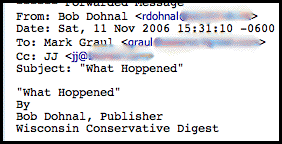
I would have thought that teaching Sykes, P-Mac, and Owen a lesson in denial and sore losership that first week after would have been enough. (I didn't think I needed to cover Dohnal's "What Hoppened," since he lives so far outside of reality everyone knows he's probably bunking with denial anyway.)

But the usually sensible Lance Burri visits denialville this week, in a post titled "Foiled by Fate":
That was 2006. Republicans lost, and Democrats won. Everything, everywhere. It was a tidal wave of 1994-esque proportions. A massive, inevitable defeat, brought on by forces that were well beyond our control.
The UW Dems' Andrew Gordon, in a post with the kind of language you'd expect from a college kid, rightly calls Lance on this:
In the end, it was this strong record of failure that cost Republicans in November. It's shocking that GOP talking heads still haven't figured it out. The Democratic Tsunami didn't come out of nowhere. Republicans made it, and lost because they consistently made wrong decisions on pretty much every issue. To blame it on fate avoids accepting any responsibilities for the shortcomings and failures of the last 12 years.
Indeed; for Lance to suggest that this year's Republican defeats were inevitable is like suggesting that the explosion at the bottom of the canyon was inevitable while forgetting that somebody had to drive off the cliff first.

In the comments to Andrew's post, Lance pipes up that he was really just "trying to figure out what we should have done differently." But, as I think Andrew's post makes clear, Lance at best makes excuses: All of these things that went wrong, he asks himself, could we have seen them and changed things? "Probably not," he answers.

This is a classic case of what we call hindsight bias. And what makes it funny is Lance's nomination of Milwaukee County Executive Scott Walker as Prophet of the Election. Never mind the reasons why Walker really dropped out of the primary (Ken Mehlman clearing the field, an inablility to raise money, God told him to), for Lance, Walker's decision--in hindsight--was prescient:
If you were planning to run for office, you had to make your decision months ago. July, June, or even earlier. Case in point: Scott Walker, who dropped out of the Governor’s race in May.

Did he know something? Did he read those tea leaves – take a long, careful look – and decide this wasn’t the year to be a Republican candidate? If so, then he is officially the smartest guy in the room, whatever room he’s in.
All hail Scott Walker, the Nostradamus of the Wisconsin GOP!

No, Lance, the responsibility lay with Republicans and six--or twelve, depending on how you want to count--years of policies designed to shrink and alienate the middle class, polarize this country along economic and religious lines, and drag our troops into unnecessary, costly, and tragic entanglements overseas. Anyone with common sense, rather than ideological blinders, could have seen the spanking coming from miles before you actually went off that cliff.
*****
I promised denial squared, and the second power here comes on the subject of Iraq, and, more specifically, Jessica McBride's waist-deep denial of what is happening in Iraq.

That post of hers merits not one but two eviscerations from the Brew City Brawler, as well as a savvy take-down from Tim Rock. Neither of them, though, hits what I think to be the most critical facet of McBride's denial here. Toward the end of a long piece asking, "Rethinking Iraq?" (her answer, "an emphatic no"), she throws this in:
In addition, I believe that many of the Democrats - and the MSM - have failed to respond to changing circumstances.
MSM, in McBride's leetspeak, is the "mainstream media," of which she is firmly a part, as an employee of the state's largest media conglomerate and host of a show on Milwaukee's highest-rated talk radio station. The irony, of course, is that the media have been, of late, responding to the changing situation on the ground, and they've been pilloried by conservative critics who can't believe, for example, that NBC should be allowed to call it "civil war."

It's McBride who goes on and on about how "we must finish the job" and "it's crucial [. . .] that we not accept defeat." But the vast bulk of the violence in Iraq today is not the United States versus anybody--it's the centuries-old conflict between Sunni and Shia with our troops being caught in the crossfire. There is a case to be made that we should be fighting the "al Qaeda in Iraq" group that has filled the void we created in Anbar Province; but al Qaeda isn't killing thousands of civillians every month. al Qaeda isn't shelling neighborhoods the way the Sunni and the Shia are.

It was absurd before the election for conservatives to suggest the the uptick in violence was an attempt to influence the vote in favor of Democrats, and it is absurd now to say that the violence is an attempt to embolden Nancy Pelosi. The violence in Iraq is being perpetrated by people who could not care less who's running this country; they are instead interested only in generations of blood debt and hostility.

Fareed Zakaria, not known for being anything close to a shrill anti-war anything, sees what McBride denies:
If you want to understand the futility of America's current situation in Iraq, last week provided a vivid microcosm. On Thursday, just hours before a series of car bombs killed more than 200 people in the Shia stronghold of Sadr City, Sunni militants attacked the Ministry of Health, which is run by one of Moqtada al-Sadr's followers. Within a couple of hours, American units arrived at the scene and chased off the attackers. The next day, Sadr's men began reprisals against Sunnis, firing RPGs at several mosques. When U.S. forces tried to stop the carnage and restore order, goons from Sadr's Mahdi Army began firing on American helicopters. In other words, one day the U.S. Army was defending Sadr's militia and, the next day, was attacked by it. We're in the middle of a civil war and are being shot at by both sides.
Is that really the position McBrides wants us to be in, to stay in, to persevere in? We're no longer on one side of this war; we're caught in a crossfire. How do you "win" when you're in a crossfire? What does "accepting defeat" even look like in that situation?

How do you decide not to "rethink Iraq," unless you've waded so far into denial that you can't see how much we've already lost?

Saturday, November 04, 2006

For Dan Kenitz

And McIlheran and Dad29 and Lance Burri:
The extension of the franchise to black citizens was strongly resisted. Among others, the Ku Klux Klan, the Knights of the White Camellia, and other terrorist organizations attempted to prevent the 15th Amendment from being enforced by violence and intimidation. Two decisions in 1876 by the Supreme Court narrowed the scope of enforcement under the Enforcement Act and the Force Act, and, together with the end of Reconstruction marked by the removal of federal troops after the Hayes-Tilden Compromise of 1877, resulted in a climate in which violence could be used to depress black voter turnout and fraud could be used to undo the effect of lawfully cast votes.

Once whites regained control of the state legislatures using these tactics, a process known as "Redemption," they used gerrymandering of election districts to further reduce black voting strength and minimize the number of black elected officials. In the 1890s, these states began to amend their constitutions and to enact a series of laws intended to re-establish and entrench white political supremacy.

Such disfranchising laws included poll taxes, literacy tests, vouchers of "good character," and disqualification for "crimes of moral turpitude." These laws were "color-blind" on their face, but were designed to exclude black citizens disproportionately by allowing white election officials to apply the procedures selectively. Other laws and practices, such as the "white primary,", attempted to evade the 15th Amendment by allowing "private" political parties to conduct elections and establish qualifications for their members.

As a result of these efforts, in the former Confederate states nearly all black citizens were disenfranchised and removed from by 1910. The process of restoring the rights taken stolen by these tactics would take many decades.

--

Prior to passage of the federal Voting Rights Act in 1965, southern (and some western) states maintained elaborate voter registration procedures whose primary purpose was to deny the vote to those who were not white. In the South, this process was often called the "literacy test." In fact, it was much more than a simple test, it was an entire complex system devoted to denying African-Americans (and in some area, Latinos) the right to vote.

The registration procedures, and the Registrars who enforced them, were just one part of this interlocking system of racial discrimination and oppression. [. . .]

In Alabama, a typical registration process for an African-American citizen went something like this:

In the rural counties where most folk lived, you had to go down to the courthouse to register. The Registrars Office was only open two or three days each month for a couple of hours, usually in the morning or afternoon. You had to take off work — with or without your employer's permission — to register. And if a white employer gave such permission, or failed to fire an African-American who tried to vote, he could be driven out of business by economic retaliation from the Citizens Council.

On the occasional registration day, the county Sheriff and his deputies made it their business to hang around the courthouse to discourage "undesirables" from trying to register. This meant that Black women and men had to run a gauntlet of intimidation, insults, and threats just to get to the Registration office. Once in the Registrars Office they faced hatred, humiliation, and harassment from clerks and officials.

The Alabama Application Form and oaths you had to take were four pages long. It was designed to intimidate and threaten. You had to swear that your answers to every single question were true under penalty of perjury. And you knew that the information you entered on the form would be passed on to the Citizens Council and KKK. [. . .]

In addition to completing the application and swearing the oaths, you had to pass the actual "Literacy Test" itself. Because the Movement was running "Citizenship Schools" to help folk learn how to fill out the forms and pass the test, Alabama changed the test 4 times in less than two years (1964-1965). At the time of the Selma Voting Rights campaign there were actually 100 different tests in use. In theory, each applicant was supposed to chose one at random from a big loose-leaf binder. In real life, some individual tests were easier than others and the registrar made sure that Black applicants got the hardest ones. [. . .] Your application was then reviewed by the three-member Board of Registrars — often in secret at a later date. They voted on whether or not you passed. It was entirely up to the judgment of the Board whether you passed or failed. If you were white and missed every single question they could still pass you if — in their sole judgment — you were "qualified." If you were Black and got every one correct, they could still flunk you if they considered you "unqualified."

Your name was published in the local newspaper listing of those who had applied to register. That was to make sure that all of your employers, landlords, mortgage-holders, bank loan officers, business-suppliers, and etc, were kept informed of this important event. And, of course, all of the information on your application was quietly passed under the table to the White Citizens Council and KKK for appropriate action. Their job was to encourage you to withdraw your application, — or withdraw yourself out of the county, — by whatever means they deemed necessary.
If you're stupid, they say, don't vote. Sounds familiar.

Dan Kenitz is stoopid

The Dan Kenitz fan club seems to have grown to four: Patrick "brilliant!" McIlheran, as I mentioned yesterday; Charlie Sykes (there's a shocker), who read Kenitz's op-ed on the air yesterday; the normally reasonable Lance Burri; and Dan Kenitz himself.

I'm sure it's done wonders for his blog traffic, too.

Let me see if I can rephrase the problem here. This week when John Kerry flubbed the punchline to a joke that would have called George W. "is our children learning" Bush stupid, Kerry was criticized for insulting the president. Flubbing the line made it seem like John Kerry was calling our troops in Iraq stupid, for which he was nearly crucified. Yet this very same week, the Milwaukee Journal Sentinel decides that the best use of its op-ed space is allowing a peurile conservative columnist to call voters--liberal voters, mostly--stupid, repeatedly. Five days before the voters go to the polls, the JS thinks its greatest contribution to the discourse is a column insulting half (give or take) of its readers in an uncreative, juvenile fashion.

It's a joke, Kenitz says. I have no sense of humor, Lance Burri says. Well, look, calling someone stupid is not funny. Lenny Bruce was funny. "Arrested Development" was funny. Some days even "Marmaduke" is funny. Kenitz's column was not funny, not even if viewed as smack talk. The high school students I teach talk funnier smack than that. (My favorite from this week: Your mama's so fat, I tried to walk around her and got lost.)

And while no, I don't think that anyone who reads Kenitz's infantile rangtings yesterday would decide not to vote becuase of it, I do think it reflects badly not just on Kenitz, anyone who praises him, and the paper, but on a lot of conservatives like that--the Jessica McBrides of the world who can't face reality. They see that they're losing, nationally and locally, and their last remaining hope is convincing themselves that no, it's not them, it's everyone else. Everyone else is stupid. Everyone else doesn't get it. Everyone else is going to ruin it. Only people who agree with me should be allowed to vote.

Kenitz, McBride, Sykes, McIlheran and the rest of you holding on to the last disappearing threads of your Bush Revolution illusion: You need to look in the mirror for a while. It isn't my missing sense of humor that is the problem here. It's you.

Monday, October 10, 2005

Campaign Finance and the Culture of Responsibility

Right Cheddarsphere denizen Lance Burri picks up on the Brian Burke Goes to Jail story, with a focus on calls for stricter campaign finance laws. He's against 'em:
We’ve already got laws on the books, and in [Burke's] case, those laws did their job. But never mind that. A pittance. A trifle. Not worth mentioning. No. We need more laws.

True, there may be episodes like Burke’s that go unprosecuted and unpunished. For example, this dreadfully underreported story: Wisconsin’s state government gave a travel contract worth $750,000 to a company that didn’t earn it, after the company’s owner gave $10,000 to Governor Doyle’s campaign.

Chicken feed, compared to the $700,000 the Indian casinos spent on Doyle’s 2002 campaign. But then, their payoff was supposed to be bigger.

Was pay-to-play involved? It sure looks that way. According to Madison’s Channel 27, at least 5 out of 7 members of the committee responsible for choosing a bidder preferred another company – the one that gave them the lowest bid.

But, when the smoke cleared, the state gave the contract to the Governor’s contributor.

It’s not likely we’ll ever prove pay-for-play. Linking a criminal act back to Governor Doyle and his administration would be next to impossible. So: that’s proof that the laws we’ve got aren’t enough. Right?

I suppose you could make that argument, but consider: in Burke’s case, a District Attorney aggressively pursued allegations of wrongdoing, which resulted in serious consequences for a powerful State Senator.

In the Governor’s case, a news team is aggressively pursuing a story. A story that looks dirty, even if all involved are really as clean and white as a Christmas Day snowfall. A story the voters deserve to hear.

End result? We – the voters – can make up our own minds when election time rolls around again.

Legal consequences in the first case. Potentially, political consequences in the second case. Because our legal system did its job, in the first case. Because our professional journalists did theirs, in the second.
To a real extent, Lance's argument makes sense. If what Burke (and Jensen and Foti and Chvala and so on) did was illegal, there are legal consequences that can be applied. If the voters disapprove of J-Dizzle's pandering (or that of Gard or others), they can vote him out. In traditional Republican parlance, this might be considered the "culture of responsibility"--when people do wrong, punish them.

I, on the other hand, take a more traditional Democratic position; I would rather see the motivation to do wrong reduced or eliminated. Take the war on drugs, for example. Republicans salivate at the thought of imprisoning addicts and dealers, while Democrats would rather bring jobs to drug-addled neighborhoods and heal, rather than punish, addictions.

In the realm of campaign finance, the Democratic solution is to eliminate the culture of corruption that led Burke (et al.) to break the law, and led J-Dizzle (and Gard) to skirt the law in his deals. Public financing of campaigns--a system like Arizona's, maybe--would eliminate the constant need to trawl for more money, stopping before they begin the kinds of crimes or ethical challenges that Doyle (and Gard) and Burke (and friends) were doing that led to prosecution or journalistic scrutiny.

Right now, Madison is so deeply mired in the business of campaigning, rather than the business of governing, that the people's business is not getting done. Republicans are too busy posturing for the Pro-Life Wisconsin crowd to effect real change, for example. Every day I get an email from some Democrat asking for money. While I could remind them that I am a humble public servant and can't afford it all, I'd rather remind them that they were elected to govern, not solicit.

So, there you have it, Lance. I'm not looking for more laws for the sake of more laws; I'm looking to change the culture of corruption in Madison. And that's not a pittance.